
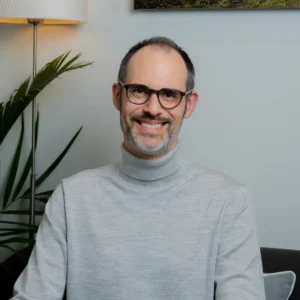
Dr. Michael Mandrusiak
Registered Psychologist #1803
One of the founders of modern psychology, Carl Jung observed that psychotherapists have taken on a role once served by priests1. I have a deep respect for the power of religion for many people, including myself. I also have to admit that as a psychotherapist, I often do feel thrust into a spiritual care role for a secular age. Many of my clients come to me asking profoundly spiritual and existential questions. What is the point to life? What really matters? Does any anything matter? Even people who have seemingly wonderful lives from an outside perspective often ask these questions. While priests have answers immediately at hand in their sacred Scriptures and holy texts, where can a psychotherapist turn for such answers? We therapists are not supposed to bring our own biases and spiritual beliefs into therapy, so we cannot simply tell our clients whatever we choose to believe for ourselves. And our empirically validated treatment protocols offer only so much help with spiritual matters.
People-Wisdom
There is only one source that I dare draw from in order to “enlighten” my clients: the wisdom of my clients themselves. It is indeed the distinct privilege of a psychotherapist that we are able to share in the intimate lives, thoughts and experiences of many of our fellow travellers who come to us as clients. I am not the source of wisdom, but simply a connective conduit, passing it along from one brave soul to another. My hope is that this people-wisdom could be helpful to both individuals who believe in God (by whichever name or names) and to those who simply believes in an ongoing reality (divine or otherwise), in which we happen to make a brief appearance. So far, my clients have shown me three potential sources of meaning, but if only one or two resonate with you, that is more than ok. Here they are:
- Certified Existence-Validator
The first point to life, my clients say, is to climb to the mountaintop or to sit beside the stream (or anywhere at all, really) and to simply experience, witness and enjoy existence, your own and that of the universe. Without you, and others like you, there would be no one to perceive and to enjoy all of existence and creation. In a way, your very being, by virtue of being a conscious and aware being who is capable of perceiving and being aware of your perceiving, thereby validates existence and gives its beauty meaning and value. A religious person might call it practice of gratitude to God’s creation or a state of enlightened transcendence, but a secular person need not call it anything at all but simply enjoy the experience of contentedness and mindful appreciation. For simplicity, let’s call this source of purpose being a “Certified Existence Validator”.
Most of us are so wrapped up in rumination with the past and worry about the future that we forget that we are Certified Existence Validators. Many of my clients come to me needing to relearn how to be what they already are.
- Not-Alone-Ness
The second point to life, my clients say, is connection and belonging with other beings. Why? Who knows! It is simply a part of being a human (or mammal, for that matter). For some reason, many (though not necessarily all) humans stop asking about the point to life when they feel love, belonging and connection, both within parts of oneself and with others. Aloneness is a fundamental human experience and relief from that aloneness in the experience of connectedness is meaningful in and of itself. A religious person might call this the manifestation of sacred love and grace for another, an outward flowing of the divine through oneself or an image or reflection of our collective longing for reconnection to the source of divine Oneness by whatever name we choose to call it. A secular person can simply call it belonging and connection. Let’s call it “Not-Alone-Ness” for short.
It is not easy to enter into the state of vulnerability that allows for this Not-Alone-Ness, and my clients’ journeys often involved grieving and shedding of defences that initially prevent them from finding deeper connection.
- Full-Me Mode
The third point to life, my clients have shown me, is to realize and express the inner essence of one’s being. There is something inside that is uniquely you and of you. And yet the world creates barriers to these parts of you being fully expressed and realized – judgement, shame, stigma, fear of rejection, lack of support and resources, fear of failure, trauma and lack of safety, all are barriers to being fully you. Of course, we can never perfectly realize ourselves outwardly, and so it is the act of striving and engaging, not the actual output, that gives life meaning and purpose. A religious person may recognize this actualization as a process of connecting with the divine within or, perhaps opening oneself to receive the gifts of the Spirit. A secular person can simply call it the discovery and expression of their true self. For both, they must often dive into dark waters deep within and, for whatever reason, when they find that core thing and draw it out more fully, it just feels right and whole and complete. Let’s call it going into “Full-Me-Mode”.
The world throws all sorts of terrifying reasons in our faces about why it is too dangerous to fully be ourselves. Many of clients learn how to find safe places, how to discern if and when these places are actually safe and then how to courageously risk going into “Full-Me-Mode” in the context of that safety.
Not a Priest. Just a People-Wisdom-Connector.
I am sure there are other lessons that I will continue to learn from my clients as they teach me more of the hidden truths of spiritual matters. For now, I can share with you that, for whatever reason, the act of being a Certified Existence Validator, connecting with a state of Not-Aloneness and going into Full-Me-Mode seems to offer many people a sense of purpose, meaning and something of eternal, spiritual significance. Connecting to this state of spiritual significance seems to make us more content with our existence and more able to tolerate the inevitable sufferings and distresses of life. None of this qualifies me to be a priest. I’d rather think of myself as a People-Wisdom-Connector.
With blessings, vibes or whatever, have a lovely, purpose-filled day!
- Jung, C. G. (2001). Psychotherapists or the clergy. In Modern man in search of a soul (pp. 244–264). Psychology Press. (Original work published 1933)